Key Highlights
- While advisors cannot control market returns, they can influence how much of those returns clients ultimately keep with proactive tax management strategies.
- Holistic tax management goes beyond tax-loss harvesting to manage gains, optimize tax lots, coordinate portfolio transitions, and improve after-tax investment outcomes over time.
- Tax-aware portfolio management can uncover opportunities in both rising and falling markets.
For many financial advisors, investment management and financial planning are viewed as the primary drivers of client outcomes. Yet for high-net-worth investors, another factor can have an equally profound impact on long-term wealth accumulation: tax management.
Taxes are among the few investment costs that are both predictable and manageable. While advisors cannot control market returns, they can influence how much of those returns clients ultimately keep through effective tax management.
Tax-loss harvesting often dominates the conversation, leaving other tax-efficient techniques underutilized. The result is a reactive approach that can leave significant value on the table.
Today's leading tax-aware portfolio management programs take a broader view. They seek not only to harvest losses when opportunities arise, but also to manage gains, optimize tax lots, coordinate portfolio transitions, and improve after-tax outcomes over time.
Why tax management matters for after-tax portfolio outcomes
Taxes may seem like a secondary consideration when markets are strong, but even modest tax drag can have a significant long-term impact.
Consider a hypothetical $500,000 portfolio earning 7.5% annually over twenty years. Without tax drag, the portfolio grows to approximately $2.1 million. With a 2% annual tax drag, the ending value falls to roughly $1.46 million – a difference of more than $665,000.
This impact becomes even more significant for affluent households, many of whom have:
- Large taxable brokerage accounts
- Appreciated legacy positions
- Concentrated stock holdings
- Liquidity needs that require periodic asset sales
- Business sales, real estate transactions, or other taxable events
For these investors, tax management is not a year-end exercise. It is an ongoing discipline in portfolio management.
So why isn’t tax management always used to its full potential? These three common myths help explain why.
Myth #1: Tax management is just tax-loss harvesting
Tax-loss harvesting is undoubtedly valuable.
However, harvesting losses is only one component of a broader tax-efficient investing framework. A more holistic approach seeks to manage the entire after-tax profile of a portfolio through a combination of techniques, including:
- Tax-loss harvesting
- Capital gains deferral
- Tax-lot optimization
- Management of short-term versus long-term gains
- Wash-sale monitoring
- Strategic retention of appreciated holdings
- Tax-aware portfolio transitions
Importantly, the objective is not simply to minimize taxes in the current year. It is to maximize after-tax portfolio outcomes over time. In some cases, realizing gains may actually be the right decision if it improves portfolio positioning or creates future flexibility.
The most effective tax-management programs therefore focus on optimizing outcomes rather than simply maximizing harvested losses.
Myth #2: Tax management only matters in down markets
Another common misconception is that tax management becomes ineffective when markets rise. In reality, tax-management opportunities often exist even during strong bull markets.
A review of S&P 500 constituents highlights why. In 2023, the index gained more than 24%, yet approximately 29% of stocks still finished the year with negative returns. In 2024, the market gained more than 23%, while roughly 34% of stocks posted losses. Even in 2025, when the index delivered another positive year, nearly 40% of constituents declined.
This creates opportunities for advisors who apply tax-aware portfolio management at the security level rather than relying solely on broad market performance. Advisors who continuously monitor portfolios can identify these opportunities throughout the year rather than waiting until December.
Tax-management opportunities are often driven by market dispersion, not market direction.
Myth #3: Tax management is impossible to quantify
Perhaps the most persistent challenge for advisors is demonstrating the value of tax management. Clients can easily see pre-tax investment returns. Tax-management benefits are less visible, but still measurable.
Budgeting for capital gains
One of the most powerful benefits of tax management is the ability to control when gains are realized. Rather than treating gain realization as a byproduct of portfolio changes, a tax-aware approach can intentionally manage the timing of gains to better align with an investor's tax situation and long-term objectives. Deferring gains allows investors to keep more capital invested and compounding over time, while thoughtful planning can also help determine when it makes sense to realize gains based on the client's broader financial picture. The value comes from timing – not eliminating – taxes.
Imagine a client owns a highly appreciated stock position with a $100,000 unrealized gain. If that gain is realized today and the client faces a combined federal and state tax rate of 25%, approximately $25,000 in taxes could be owed. By strategically deferring the sale, that $25,000 remains invested and continues compounding alongside the rest of the portfolio. While the tax may eventually be paid, delaying the liability allows the client to keep more capital working on their behalf in the meantime.
Tax-loss harvesting benefits
Harvested losses remain an important source of value within a tax-loss harvesting strategy when they are aligned with client needs.
For example, losses may offset:
- Portfolio-generated gains
- Gains from a business sale
- Real estate transactions
- Stock option exercises
- Other external taxable events
The key is not how many losses were harvested, but whether they create meaningful economic value. This distinction is particularly important for high-net-worth clients, whose largest tax events often occur outside their investment portfolios. In these situations, harvested losses may become significantly more valuable because they can offset gains generated elsewhere.
Maintaining tax flexibility
One often-overlooked benefit of tax management is preserving future after-tax portfolio management flexibility. Aggressive harvesting strategies, especially when combined with a reluctance to realize any capital gains, can, over time, result in a situation where no trading can take place in the account because there are no remaining losses to harvest. This scenario is often referred to as "portfolio lock", essentially rendering an account unmanageable unless cash contributions are made to the account.
In contrast, a balanced approach, that seeks to control the timing of gains through a gains budget, may help maintain portfolio management flexibility over an extended timeframe. Data from approximately $15 billion of tax-managed assets showed that accounts opened before 2021 still generated loss-harvesting opportunities of roughly 2.6% of account value in 2025, compared with approximately 3% for newer accounts. A measured approach can continue creating tax-management opportunities, while also keeping the account aligned with the target portfolio model, over an indefinite time period.
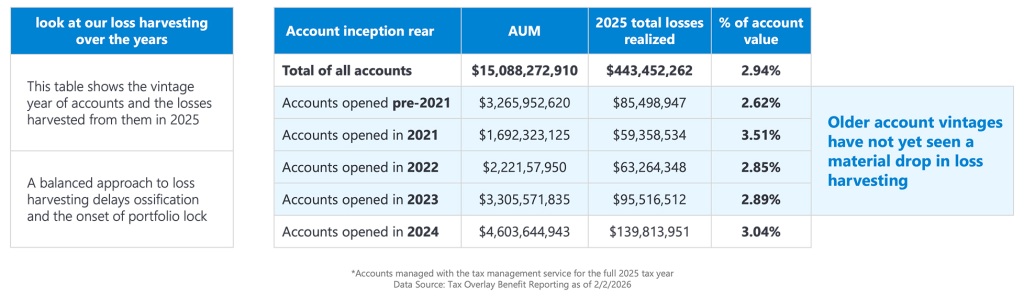
For advisors, this highlights an important lesson: maximizing tax benefits this year should not come at the expense of reducing opportunities in future years.
What modern tax management looks like
As advisors increasingly serve high-net-worth clients with complex financial lives, the conversation is shifting from individual tax-saving transactions to ongoing after-tax wealth management. It requires balancing multiple objectives:
- Managing gains and losses
- Preserving investment integrity
- Maintaining flexibility for future planning opportunities
- Aligning tax-aware portfolio decisions with each client's tax circumstances
Portfolio management platforms like Envestnet Tamarac can help RIAs put these principles into practice. By automating tax management, Tamarac is designed to make it easier to manage gains, identify loss-harvesting opportunities, and keep portfolios on track with target models.
Envestnet also offers a Fund Strategist Tax Management Service providing continuous portfolio monitoring for client accounts invested in mutual funds and ETFs. Rather than treating tax management as a year-end event, the platform tracks year-to-date gains and evaluates the tax impact of portfolio changes year round.
Taxes, after all, are not an annual planning consideration. They are a persistent factor that can influence after-tax investment outcomes year after year.
See how Envestnet Tamarac can help you move past the myths and make tax management part of everyday portfolio management.