High-net-worth investors (HNWIs) want to feel like they are your most important client. They expect access to sophisticated investment options, tailored advice, and a level of service that reflects the complexity of their financial lives. Ultimately, they want to feel valued beyond simply being part of your book of business—they want your team to support their entire family’s long-term financial well-being.
A high-net-worth individual is generally defined as someone with $1 million or more in liquid financial assets, excluding their primary residence. As wealth increases, clients may also fall into categories such as very-high-net-worth or ultra-high-net-worth, which introduces additional planning complexity and a broader set of financial opportunities and risks. These investors often require specialized high-net-worth strategies that go beyond traditional financial planning due to tax exposure, estate considerations, and access to alternative markets.
To help advisors deliver the level of customization these clients expect, firms increasingly rely on dedicated services, such as high-net-worth portfolio management, that provide institutional-grade research, portfolio construction, and planning support designed specifically for affluent households.
To that end, we’ve identified four pillars of delivering a hyper-personalized HNW client retention strategy that your team can implement to better serve clients with substantial financial assets and multigenerational goals.
Core strategies for serving high-net-worth clients
While each client’s situation is unique, there are several foundational disciplines that consistently form the backbone of effective financial planning for affluent families. These areas work together to preserve wealth, manage risk, and support long-term legacy objectives.
Key strategies include:
- Tax planning to minimize liabilities and improve after-tax returns
- Estate planning to ensure efficient wealth transfer and protect family interests
- A disciplined investment strategy aligned with liquidity needs, risk tolerance, and long-term goals
- Comprehensive risk management, including insurance and liability planning
- Charitable planning to support philanthropic goals while enhancing tax efficiency
- Strategic use of alternative investments to diversify portfolios beyond traditional stocks and bonds
Each of these components plays a distinct role in a comprehensive high-net-worth strategy. In the following sections, we’ll explore how advisors can operationalize these disciplines to deliver more personalized, resilient client outcomes.
4 pillars of HNW client retention
Let’s explore each strategy and some actionable tactics that you can implement in your own advisory practice.
1. Deliver educational support
Positioning yourself as a source of reliable, accurate, and robust financial information is a powerful way to deliver value to your clients. When clients believe that you have the best information, they won’t need to search elsewhere for it. Ideally, you’d like your clients to think, “I need to make a decision about X… I’d better reach out to my wealth manager to understand my options.”
Practically, educational support can take several forms depending on your practice.
- Current market outlooks and commentaries—Setting up blogs or resource libraries on your website can create a valuable, curated information hub for your clients to access on demand. This content can also be repurposed into monthly or quarterly newsletters that are delivered directly to your clients’ inboxes.
- Specific investing themes—When presenting recommendations to clients, organize them into investing themes or categories. Examples might include:
- The benefits of staying invested for the long-term (e.g., time in the market vs. timing the market)
- Portfolio allocation considerations during rising interest rates
- Value vs. growth
- How missing the best days in the market can impact portfolio returns
This structure can really enhance your conversations with your clients. They’ll walk away both knowing more than when they arrived and also understanding the thought process behind your recommendations.
- Appropriate product expectations—Clients will often complain to their advisors when their portfolio doesn’t have the same performance as the market. Advisors have an opportunity to set proper expectations around:
- The products your clients are invested in and how they align with their suitability/ risk questionnaires
- The potential benefits of sticking with their portfolio and how movement during times of volatility could affect meeting their financial goals
- When you would recommend making movements
Setting clear expectations sets your relationship with your client up for success. This is an opportunity to expand your clients’ understanding of investing and wealth management so that they can make informed decisions. It is also an opportunity to increase transparency, which ultimately builds trust.
Writing a slide, email, or short blog post about the difference between “timing the market” and “time in the market” is a great place to start.
Advisors spend a lot of time with their clients recommending a portfolio designed to meet their specific goals while considering their risk and suitability profiles. Ultimately, attempting to time the market undermines this plan and may cause deviations in a client meeting their goals.
2. Broaden your value proposition
The second pillar of our hyper-personalized HNW client retention strategy is to offer an expansive selection of products and services. You want clients to see you as a wealth management “one-stop shop” rather than just someone to call about investments.
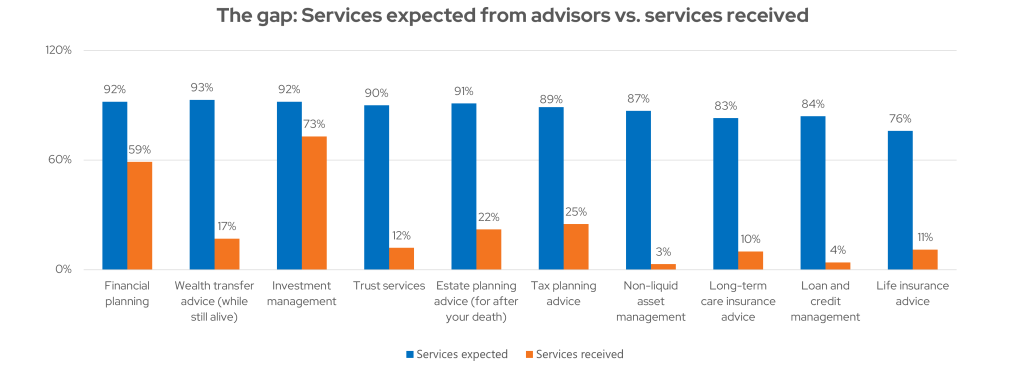
When it comes to financial planning and wealth management, most clients are receiving the services they expect. But when it comes to all other aspects of truly holistic planning, most clients do not feel they are receiving the services they expect. Adding more services to your value proposition increases your ability to meet HNWI needs. Specifically, there is large demand for tax planning advice, estate planning advice, and wealth transfer advice.
Adding these services is by no means easy to do on your own, which is why many advisors seek strategic partnerships in these areas. Today’s financial advisors tend to spend 800+ hours a year (40% of their time) on investment management.1 But consider that outsourcing investment management can free up hundreds of hours a year for client management and other activities.
In fact, outsourcers have been found to add $14.5M to their assets annually, twice as much as everyone else. Data also shows that outsourcers tend to add 14 new clients each year, rather than the average four from non-outsourcers.2
In order to meet the long-term needs of your high-net-worth families and retain their business, focus on finding the partnerships that will empower you to expand your value proposition to include the services HNW clients want.
3. Personalize tax management
As 89% of clients expect their advisor to deliver tax planning advice, integrating tax management into your services is crucial for personalization.3 One way to accomplish that is to factor tax management into more of your conversations.
Implementation tactics might include:
- Explain how your recommended allocations address the client’s tax concerns.
- Incorporate tax-loss harvesting (if you haven’t already) and taking the time to explain it to your clients.
- Careful rebalancing that maintains a diversified portfolio and manages taxable income and events, possibly by using tax-advantaged accounts or using new contributions to adjust the portfolio mix.
Your HNW clients do not want one-sized-fits-all solutions. When you explain how you are taking steps to manage their unique tax situation, you are also explaining how you are delivering personalized service and value to their family.
4. Use actionable data for values alignment
Leveraging "actionable data analysis" to align a client’s values with their investment strategy involves using detailed data to identify and invest in companies or funds that match the client's ethical, environmental, and social priorities. For instance, analyzing data on corporate sustainability, social impact, and governance practices can help identify investment opportunities that resonate with a client's values, such as supporting green energy initiatives or companies with strong labor practices. This approach not only meets the client’s financial goals, but also ensures their investments reflect their personal beliefs, enhancing client satisfaction and long-term engagement.
76% of HNWI under 40 list ESG as an important investment objective.4
Tip: Use asset titling to start the conversation
The topic of asset titling is a great conversation starter for wealth managers and an opportunity to provide value to HNWI because it touches on several crucial aspects of financial planning and can reveal much about a client's situation, goals, and potential risks. By initiating a conversation about asset titling, wealth managers can delve into topics such as asset ownership and protection, estate planning and tax implications, and, of course, family dynamics. These critical areas can provide a comprehensive understanding of the client's situation and needs, opening the door to more detailed and tailored financial planning services.
How to build lasting HNW client relationships
To deepen engagement with HNW clients, prioritize active listening to uncover nuanced personal and financial priorities, then translate those insights into bespoke solutions that reflect their evolving needs. Reinforce trust through consistent, high-touch interactions—such as in-person meetings and proactive outreach—paired with tailored communications like personalized emails and curated insights. This combination signals attentiveness, discretion, and a commitment to delivering a truly individualized client experience.
Retaining HNW clients hinges on understanding their unique needs and delivering a sophisticated, personalized experience. By focusing on educational support, an expansive product selection, tax management strategy, and actionable data analysis, wealth managers can create a hyper-personalized approach that not only meets but exceeds client expectations. Through these efforts, wealth managers can position themselves as indispensable partners, dedicated to supporting both the financial and personal goals of their HNW clients… which is good news both in terms of retaining their existing book of HNW business and attracting new HNW clients.
Learn more about how Envestnet Private Wealth can help you better serve high-net-worth clients.