Alternative investments and private markets, once the exclusive domain of institutional and ultra-high-net-worth investors, are increasingly finding their way into wealth conversations with high-net-worth individuals and families.
The numbers tell a compelling story. The global alternative investment market, estimated at around $15 trillion in 2022, is projected to surge to over $24 trillion by 2028.1 84% of wealth managers expect alternative allocations to rise in the next 12 months, while firms are rapidly expanding their alternatives capabilities with hundreds of new hires and dedicated specialist teams.2 Part of this shift is likely due to the drop in publicly traded companies over the last 20 years. The number of publicly traded companies in the U.S. peaked at 7,300 in 1996. It's now down to just 4,300.3
HNW investors are looking for additional portfolio options. Let’s dig deeper into what they are and why they may be a good fit for some investors.
What are alternative investments?
At its core, "alternatives" or “alts” is simply shorthand for anything outside the traditional trio of stocks, bonds, and cash. This broad category encompasses private equity, private credit, real estate, hedge funds, infrastructure, commodities, and even collectibles. However, what's crucial to understand is that not all alternatives are created equal. They vary dramatically in terms of risk, liquidity, and accessibility.
Advisors need to be aware of the complex regulatory landscape, as navigating legal and compliance requirements for alternative products is often cited as significant. Furthermore, a deep understanding of the nuanced tax implications—including structure, reporting, and the strategic use of tax-managed strategies—is paramount to delivering optimal after-tax returns.
This complexity is challenging. 44% of wealth managers agree that it's harder to research alternative products than traditional investments.4 But complexity shouldn't be confused with impossibility. With the right resources, alternatives can become a useful portfolio tool in your advisory arsenal.
Why high-net-worth clients want alternatives
According to Cerulli and Boston Consulting Group analyses, in 2024 approximately 8.5% of HNW investors' portfolios were allocated to alternatives, compared to 3% for affluent investors. That could be shifting. Wealthy clients often seek the kinds of sophisticated investment opportunities traditionally reserved for institutions and ultra-wealthy families. Beyond potential returns, many are also drawn to the diversification and long‑term growth opportunities that alternatives offer compared to more traditional public market investments.
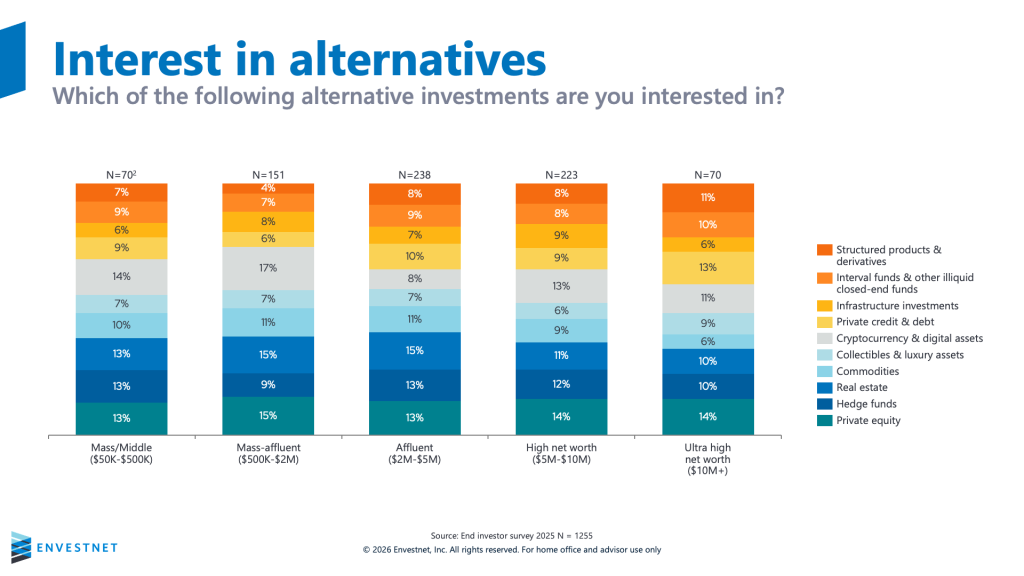
Some high-net-worth clients may be candidates for alternatives if they possess three key characteristics:
- Longer investment time horizons
- Capacity to handle significant illiquidity
- Stronger appetite for portfolio customization
These clients increasingly expect institutional-quality portfolios and want access to opportunities beyond public markets. We’re finding this to be particularly true for the investors we call “mid-tier millionaires” with assets in the $5-30 million range. Mid-tier millionaires have traditionally been underserved by the wealth management industry, offering financial advisors an attractive opportunity. Offering alternatives can become a differentiator, helping you stand out in a crowded field while delivering tangible value to clients.
Hypothetical use cases for alternatives
The business owner couple
Alex and Priya, a married couple in their early 50s, built a successful regional construction business and recently sold it. With the liquidity event behind them, they approached their advisor with a big question: “We don't want everything sitting in the stock market—what else is out there?”
They were looking for ways to preserve their wealth, generate a reliable income stream, and reduce their exposure to market swings. Their advisor introduced the idea of private credit and real estate investments, explaining how these alternatives could complement their traditional portfolio. For Alex and Priya, alternatives weren't about chasing higher returns—they were about stability, diversification, and making their money work as hard as they had.
The next-gen inheritor
Jon, a 38-year-old tech executive, recently inherited significant wealth from his parents. When meeting with his advisor, he asked, “Why does my portfolio look exactly like everyone else's? I want access to opportunities I can't get in the public markets.”
For Jon, the appeal of alternatives was twofold: the chance to invest in innovative areas like private equity and venture capital, and access to investments outside public markets. His advisor positioned alts as a way to pursue growth while also balancing risk across different asset classes. For Jon, introducing alternatives became not just a portfolio strategy but also a way to align his wealth with his forward-looking mindset.
Alternatives are here, whether you are ready or not
For many advisors, alternatives can feel like a leap from familiar, liquid markets into a more complex and less transparent landscape. That hesitation is understandable. But the trajectory of the market and client expectations suggests that “waiting until it’s simple” may not be a viable strategy.
The reality is that alternatives are becoming less of a niche offering and more of a core component in high-net-worth portfolio construction. Clients are asking better questions, seeking broader opportunity sets, and comparing their portfolios not just to benchmarks, but to institutional standards. Ignoring that shift risks leaving both value and differentiation on the table.
That doesn’t mean you need to become an alternatives specialist overnight. It does mean starting to build a working fluency: understanding the role different alt strategies can play, knowing which clients are appropriate candidates, and identifying the right partners, and learning how to talk to your clients about alternatives in a clear, accessible way.
The path forward is incremental. Begin with client segments where the fit is most obvious—those with longer time horizons, liquidity flexibility, and a desire for customization. Focus on education, both for yourself and your clients. And prioritize disciplined portfolio construction over product selection alone.
Alternatives aren’t a replacement for traditional investments. They’re a complement. Used thoughtfully, they can help you deliver more resilient, tailored portfolios and position your practice for where the industry is heading, not where it’s been.
Curious how interval funds bridge the gap between public and private markets? Read our introductory guide.