How to speak with clients about alternative investments

Alternative investments and private markets, once the exclusive domain of institutional and ultra-high-net-worth investors, are increasingly finding their way into wealth conversations with high-net-worth individuals and families.

The numbers tell a compelling story. The global alternative investment market, estimated at around $15 trillion in 2022, is projected to surge to over $24 trillion by 2028.1 84% of wealth managers expect alternative allocations to rise in the next 12 months, while firms are rapidly expanding their alternatives capabilities with hundreds of new hires and dedicated specialist teams.2 Part of this shift is likely due to the drop in publicly traded companies over the last 20 years. The number of publicly traded companies in the U.S. peaked at 7,300 in 1996. It's now down to just 4,300.3 High-net-worth investors are looking for additional portfolio options.

As access to alternatives and private markets expands, financial advisors can expect more clients to ask about how they fit into portfolios, whether out of sheer curiosity or with a request to incorporate them into their portfolios. With that comes education. Advisors need to be prepared to help clients understand the potential benefits and the very real limitations of alts, to identify who is best suited for these types of strategies within a broader portfolio.

What are alternative investments?

At its core, "alternatives" or “alts” is simply shorthand for anything outside the traditional trio of stocks, bonds, and cash. This broad category encompasses private equity, private credit, real estate, hedge funds, infrastructure, commodities, and even collectibles. However, what's crucial to understand is that not all alternatives are created equal. They vary dramatically in terms of risk, liquidity, and accessibility.

Advisors need to be aware of the complex regulatory landscape, as navigating legal and compliance requirements for alternative products is often cited as significant. Furthermore, a deep understanding of the nuanced tax implications—including structure, reporting, and the strategic use of tax-managed strategies—is paramount to delivering optimal after-tax returns.

This complexity is challenging. 44% of wealth managers agree that it's harder to research alternative products than traditional investments.4 But complexity shouldn't be confused with impossibility. With the right resources, alternatives can become a useful portfolio tool in your advisory arsenal.

Why high-net-worth clients want alternatives

According to Cerulli and Boston Consulting Group analyses, in 2024 approximately 8.5% of HNW investors' portfolios were allocated to alternatives, compared to 3% for affluent investors. That could be shifting. Wealthy clients often seek the kinds of sophisticated investment opportunities traditionally reserved for institutions and ultra-wealthy families. Beyond potential returns, many are also drawn to the diversification and long‑term growth opportunities that alternatives offer compared to more traditional public market investments.

*Risk and liquidity levels for alternative investments can vary significantly based on the specific strategy, structure, and market conditions.

Some high-net-worth clients may be candidates for alternatives if they possess three key characteristics:

  1. Longer investment time horizons
  2. Capacity to handle significant illiquidity
  3. Stronger appetite for portfolio customization

These clients increasingly expect institutional-quality portfolios and want access to opportunities beyond public markets. We’re finding this to be particularly true for the investors we call “mid-tier millionaires” with assets in the $5-30 million range. Mid-tier millionaires have traditionally been underserved by the wealth management industry, offering financial advisors an attractive opportunity. Offering alternatives can become a differentiator, helping you stand out in a crowded field while delivering tangible value to clients.

Hypothetical use cases for alternatives

The business owner couple

Alex and Priya, a married couple in their early 50s, built a successful regional construction business and recently sold it. With the liquidity event behind them, they approached their advisor with a big question: “We don't want everything sitting in the stock market—what else is out there?”

They were looking for ways to preserve their wealth, generate a reliable income stream, and reduce their exposure to market swings. Their advisor introduced the idea of private credit and real estate investments, explaining how these alternatives could complement their traditional portfolio. For Alex and Priya, alternatives weren't about chasing higher returns—they were about stability, diversification, and making their money work as hard as they had.

The next-gen inheritor

Jon, a 38-year-old tech executive, recently inherited significant wealth from his parents. When meeting with his advisor, he asked, “Why does my portfolio look exactly like everyone else's? I want access to opportunities I can't get in the public markets.”

For Jon, the appeal of alternatives was twofold: the chance to invest in innovative areas like private equity and venture capital, and access to investments outside public markets. His advisor positioned alts as a way to pursue growth while also balancing risk across different asset classes. For Jon, introducing alternatives became not just a portfolio strategy but also a way to align his wealth with his forward-looking mindset.

8 steps to talking about alternatives with your clients

When we introduce alternative investments, our goal isn’t to steer clients toward a particular product. It’s to help them understand whether these strategies practically align with their goals, preferences, and constraints. The most effective conversations are grounded in careful listening, education, and a disciplined evaluation process.

  1. Begin with the client’s situation, not with solutions
    Start by understanding what’s prompting the conversation. Are they expressing concerns about concentrated exposure? Do they have questions about volatility? Interest in accessing different sources of return? This clarity helps us determine whether alternatives are even worth exploring—not every client needs to be pointed in that direction.

  2. Use familiar portfolio concepts as a foundation
    Many clients think about their portfolios in terms of growth (equities) and stability (bonds). Position alts simply as potential additional building blocks that may address specific needs. This isn’t about abandoning the 60/40 framework—it’s about providing context so clients can decide whether additional tools are appropriate for them.

  3. Address key considerations up front—especially liquidity, valuation and fees
    For clients evaluating alts, four questions consistently emerge:
    Liquidity: “How often can I access my money?”
    Valuation: “Will I get daily, monthly, or quarterly valuations and will they be market-based or fair-based?
    Fees: “What costs should I expect?”
    Complexity: “Will I be able to understand this?”

Set expectations early, particularly around illiquidity and fees, so clients can make an informed decision about whether these characteristics align with their comfort level and time horizon

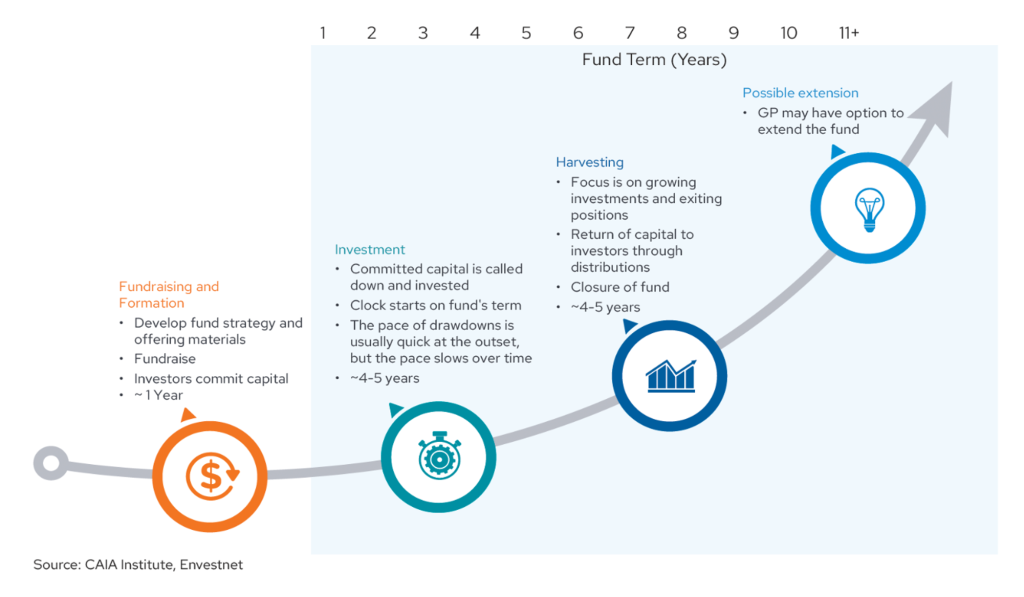
The lifecycle of a private market fund could be 10 years or more
  1. Translate concepts into everyday language
    Alternatives can feel abstract. Use plain-language examples to help clients understand the underlying economic activity. For instance, instead of referencing “private credit,” explain that some strategies involve lending to established businesses. The goal is clarity, not persuasion.

  2. Consider a measured approach if the client appears suitable
    When a client’s situation suggests that alts might be appropriate, a small initial allocation can be a prudent way to assess comfort and portfolio fit. This step is always about testing suitability, not encouraging participation.

  3. Provide context without exerting pressure
    It can be helpful to share how other clients in similar circumstances have approached the decision—without implying that those choices should dictate someone else’s. Context can normalize the discussion while keeping the focus on the individual client’s needs.

  4. Emphasize your due-diligence process
    Rather than highlighting return potential, walk clients through how alternative strategies are evaluated, risks are assessed, and fit is determined. A disciplined process reassures clients that any consideration of alts is grounded in rigor, not trend-following.

  5. Clarify next steps, even if the next step is “pause”
    Every conversation should end with a clear plan—whether that’s gathering more information, reviewing educational material, updating the client’s financial plan, or deciding that alternatives aren’t the right fit at this time.

A visual representation of variables to consider for various options can be really helpful in these conversations.
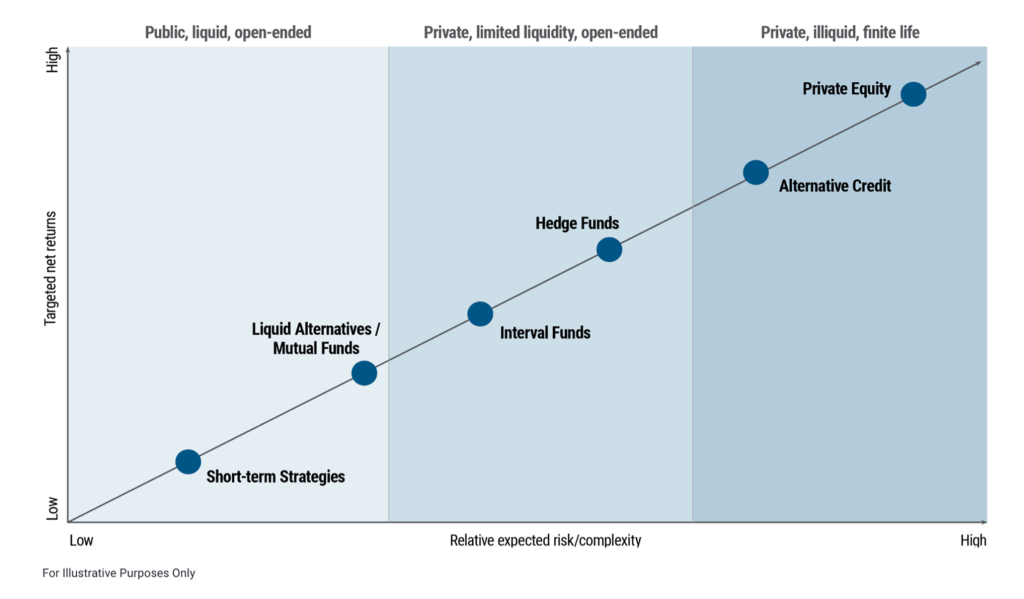
Source: PIMCO as of 31 December 2023. Return reflects a 60/40 portfolio represented by 60% U.S. equities and 40% U.S. core fixed income.

These conversations are important

"At Envestnet, our vision is to unify a historically siloed alternatives universe, so that these asset classes no longer feel like 'alternatives.' By automating burdensome workflows, and adding transparency and clarity to portfolio performance, we can level the playing field for advisors in accessing and integrating private markets. This opens up a whole new world of opportunity for strengthening client portfolios by adding diversification and offering greater return and income potential."

Dana D'Auria, CFA, Co-Chief Investment Officer and Group President, Envestnet Solutions

Alternative investments aren’t a passing trend, but that doesn’t mean they’re right for every client. Depending on a client’s liquidity needs, risk tolerance, and time horizon, alternatives may play an important role in a thoughtful, well-constructed portfolio. Our responsibility is to help evaluate those factors carefully and introduce alts only when they align with the client’s goals and preferences.

Advisors who build the expertise to assess and explain these strategies will be well-positioned to support clients as interest in alternatives continues to grow. The question isn’t simply whether alternatives will become more common across wealth management; it’s whether you’ll have a clear, disciplined approach in place when clients want to understand how (or if) they fit into their plan.


Curious how interval funds bridge the gap between public and private markets? Read our introductory guide.


The information, analysis and opinions expressed herein are for informational purposes only and do not necessarily reflect the views of Envestnet. These views reflect the judgment of the author as of the date of writing and are subject to change at any time without notice. Nothing contained in this piece is intended to constitute legal, tax, accounting, securities, or investment advice, nor an opinion regarding the appropriateness of any investment, nor a solicitation of any type.


Alternative Investments may have complex terms and features that are not easily understood and are not suitable for all investors. You should conduct your own due diligence to ensure you understand the features of the product before investing. Envestnet and its affiliates do not provide research or product oversight on alternative investments. As with all investments, there is no assurance that alternative investment strategies will achieve their objectives or protect against losses.


5381032


FOR INVESTMENT PROFESSIONAL USE ONLY ©2026 Envestnet, Inc. All rights reserved.


1https://www.kkr.com/insights/alternative-perspective-past-present-future

2https://www.bny.com/corporate/global/en/insights/wealth-trends-in-alternatives-optimizing-opportunities.html

3https://eqtgroup.com/thinq/equity/why-is-the-stock-market-shrinking

4https://www.bny.com/corporate/global/en/insights/wealth-trends-in-alternatives-optimizing-opportunities.html