As the complexity of financial markets, tax laws, retirement and estate planning grows, so does the demand for holistic advice tailored to individual life goals. With advancements in financial planning technologies, advisors are now able to offer in-depth planning as a value-driven service rather than an added bonus. Charging for financial planning reflects its importance in delivering personalized, comprehensive strategies that go beyond simple investment management, ensuring long-term financial success for clients.
To better understand how advisors charge for planning, Envestnet | MoneyGuide and Datos Insights conducted a web-based survey in 2026 of 491 advisors, including responses from Registered Investment Advisors, Independent Broker Dealers, and financial service firms. Our analysis shed light on the influence of advisor fees, helping advisors make informed decisions about their practice. Here are just a few of the key insights for advisors.
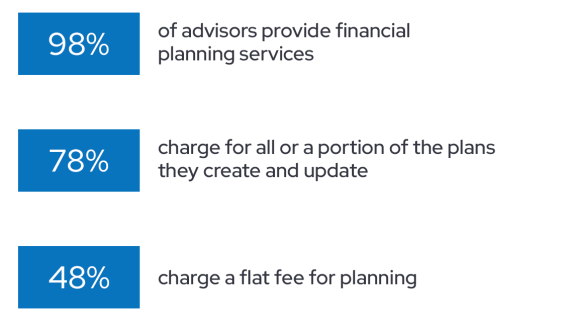
98% of advisors provide financial planning services
Financial planning has transitioned from a differentiating service to a near-universal practice expectation, with 98% of the advisors surveyed providing financial planning services.
Along with extending financial planning to more clients, advisors are charging for their planning services. Among the advisors surveyed, 53% charge for all the plans they create or update, up from 37% in 2023. Another 25% charge for a portion of the plans they create and update. This growing monetization of planning services highlights the need for financial advisors to carefully weigh the pros and cons of different fee models to remain competitive and profitable.
Of the advisors surveyed…
A shift back toward comprehensive planning
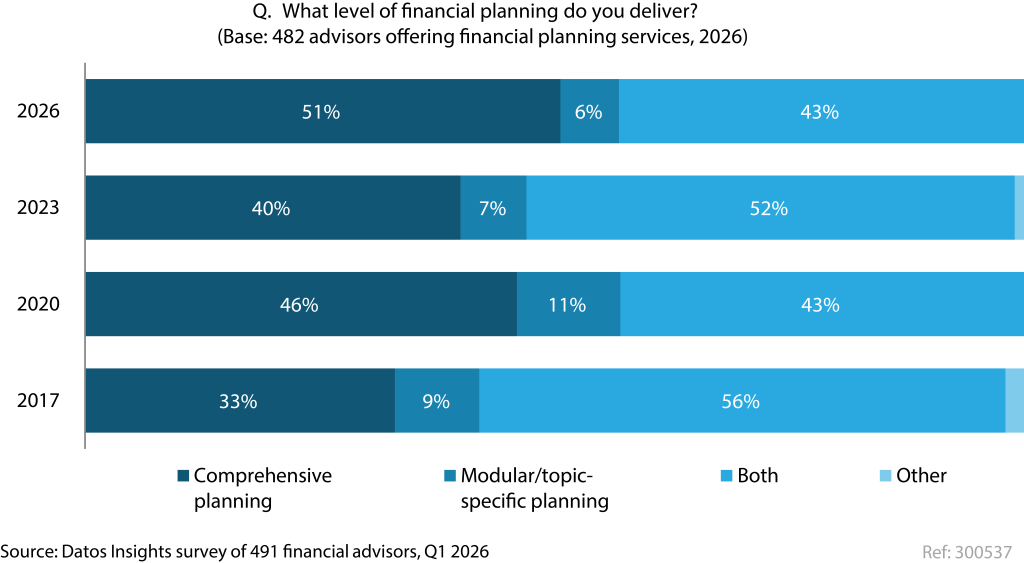
In 2026, 51% of advisors reported offering comprehensive planning services exclusively, an 11% increase since 2023. The share of advisors delivering both modular and comprehensive planning services has declined from 52% in 2023 to 43% in 2026. This shift toward comprehensive planning may reflect a response to various factors, such as growing client demand for ongoing, holistic guidance as their financial lives become more complex.
Level of planning
Comprehensive planning, which includes ongoing client engagement and check-ins, often requires higher fees but delivers more value. Modular planning, on the other hand, focuses on specific financial goals or life stages and may appeal to clients with less complex needs. Advisors may find that their practices are better served by positioning comprehensive planning as their primary value proposition, with modular components integrated rather than offered as stand-alone products.
Choosing the right fee model drives business growth
Selecting the right fee model is crucial for aligning your services with your business objectives, including:
- Client segmentation: Identifying ideal clients and their financial needs allows advisors to tailor their pricing. Are they younger clients with growing incomes but fewer assets, or are they retirees with substantial savings who require more complex planning? Segmentation helps advisors tailor their services and pricing accordingly.
- Scope of services: Charging higher fees for more complex services, such as estate planning or tax planning, delivers greater value to clients and will impact pricing, therefore justifying the cost.
- Growth strategy: Advisors should decide whether their goal is to prospect for new clients or focus on deepening relationships with their existing client base. This strategic decision can influence how fees are structured, particularly whether advisors choose to charge for new plans or only for plan updates.
- Payment flexibility: As client demographics and preferences shift, flexibility in fee structures becomes increasingly important. For example, younger clients with growing incomes may prefer to pay for financial plans over time rather than in a lump sum, while older clients may have different payment preferences. Understanding these nuances can help advisors build more sustainable and attractive pricing models that align with their business objectives and goals.
A strong value proposition justifies your fees
Clients are willing to pay for financial planning when they clearly see its value. Advisors who help them achieve their financial goals through well-crafted strategies, offer ongoing support, invest time in understanding client needs, educating them about financial options, and delivering tailored solutions will find it easier to justify their fees.
Fees will continue to evolve
Generally, we believe the survey findings suggest that the financial planning industry is moving toward fee-based models as clients increasingly recognize the value of personalized, ongoing financial advice.
As financial planning technology continues to advance, advisors are better equipped to deliver more personalized and efficient solutions for their clients at scale. By integrating these tools into their practice, advisors can not only enhance the value of their services but also create more flexible, scalable fee models that align with their business goals and growing client needs.
Download the full whitepaper: 2026 State of Financial Planning Fees