Key Highlights
- AI is raising the bar for advisors. As clients grow more comfortable using AI for financial guidance, advisor value must be clearly demonstrated, not assumed.
- Planning is one of the clearest proof points. Quantifying recommendations helps advisors show measurable impact.
- Human insight remains essential. Trust, context, and guidance for life events can’t be replaced by AI.
- A strength is human + AI. Technology combined with a human touch can help advisors scale efficiency and enhance insights to deliver more personalized, proactive advice.
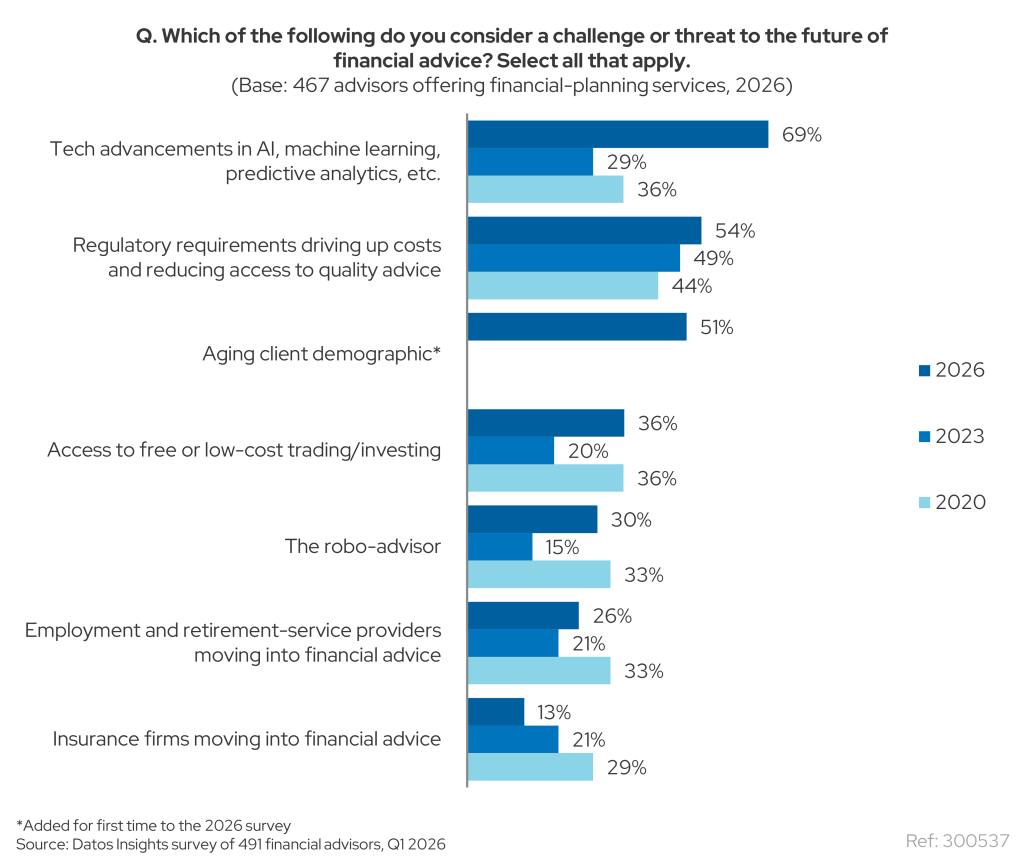
When financial advisors were asked what the biggest challenge to the future of financial advice was, the number one answer was artificial intelligence.1 The industry has moved from curiosity about AI to alarm to a sense of urgency in less than three years, with advisors’ concern about AI and machine learning rising from 29% in 2023 to 69% today, according to a survey by Datos Insights for Envestnet MoneyGuide.1
It’s easy to see why. Clients today have more access to low-cost financial information than ever before, and younger investors are increasingly turning to AI-driven tools over traditional advisory relationships. Nearly 80% of younger investors now use AI in some capacity for financial advice – and many are making poor decisions because of it.2
For advisors, the question is no longer whether AI will change the industry (it already has), but how to show their value above and beyond AI. The pressure is real. But so is the opportunity.
4 ways to help demonstrate advisor value
Clients can use AI to answer a financial question in seconds, but smart tools can’t compete with a trusted advisor who understands them. Here are four ways advisors can make that distinction clear.
Lead with planning
Planning technology has become the primary vehicle through which advisors make their case.
According to the Datos Insights/Envestnet MoneyGuide survey, 79% of advisors report using planning technology to compare the client’s current financial scenario with their recommended plan to quantify the impact of their advice. This is one of the most direct forms of value demonstration, since it puts a concrete number on the advisor’s contribution. Another 78% of advisors use planning software to deliver financial reports. 77% also offer personalized client portal access to give clients greater insight into their unique financial situation.
When advisors use planning technology to clearly illustrate the impact of their guidance, the value of that relationship becomes tangible.
Strengthen the human connection
While technology has become integral to financial services, successful financial advisors are reinforcing their value by pairing it with a human touch. Along with anchoring client engagements in financial planning rather than performance metrics, these advisors treat financial planning not as a one-off conversation, but as part of a long-term relationship.
“When you make financial planning the center of your client's relationship, you become a critical part of the most important moments in their life. Kids graduating. Career changes. Sale of a business. Weddings. Retirement. Funerals… you get invited to these things. You’re there because you became their trusted advisor.”
Scale time saved through AI
AI-driven automation that aligns with how advisors do business can streamline routine administrative tasks and enable advisors to serve more clients while maintaining a high-touch practice.
By pinpointing the tasks that AI can automate – like information gathering, routine plan updates, scenario modeling, and even basic tax optimization – and delegating these tasks to AI-powered tools, advisors can free up time for the higher-value client work that only they can do. AI can also proactively alert clients to next steps and check-in meetings to keep clients engaged without adding to the advisor’s plate.
By spending less time on administration, advisors have more time for the conversations that matter.
Elevate advice with AI-driven insights
Arguably one of the leading potential benefits of using AI in wealth management is the ability to turn data into insights and enable advisors to deliver advice that’s more strategic and personal.
Advisors have data – even too much, which can result in overload, inconsistency, and missed opportunities. The leading AI tools can address this gap by applying behavioral context and business strategy to raw data, to help advisors identify the risks, inefficiencies, and meaningful opportunities in a client’s financial picture.
This AI-powered decision intelligence can be used to:
- Prioritize outreach across large books
- Standardize high-impact conversations
- Ensure important opportunities do not get missed (whether related to performance, tax efficiency, cash flow, or life events)
- Keep plans current, surface what matters most, and support continuous engagement
- Move from reactive service to proactive guidance
Successful advisors use AI to surface the right moments, and human expertise to turn those moments into meaningful outcomes for clients and sustainable growth for their practice.
After all, AI, when used correctly, is designed to enhance advisor judgment, not replace it.
“AI is not a substitute for human advice, but a catalyst for better advice.”
Datos Insights/Envestnet MoneyGuide 2026 State of Financial Planning Fees
Technology enables the shift
Knowing how to demonstrate value is one thing. Having the tools to do it consistently is another. Envestnet technology is designed to help advisors do both. From creating a comprehensive financial plan to walking into client meetings with a compelling story to tell, our Adaptive WealthTech is designed to help advisors become an integral part of their clients’ lives.
Value creation for prospects: Dash
Two of the biggest barriers to financial planning today boil down to advisor time and client hesitation to get started. That’s where Dash can come in. This interactive planning tool enables advisors to pull in underserved clients and prospects of any portfolio size to create a basic plan in minutes, laying the groundwork for a strategic planning discussion.
Value demonstration: MoneyGuide
One of the most widely adopted financial planning solutions in the industry, MoneyGuide helps advisors go beyond asset management to deliver holistic, goal-based and cash-flow financial wellness. Through interactive modeling, advisors can build, stress-test, and update comprehensive financial and retirement plans, and work closely with clients on the goals that matter most.
Value storytelling: Report Studio
As an AI-powered, dynamic client reporting tool, Report Studio enables advisors to create a customized report and a story complete with talking points for client conversations. AI-driven natural language querying and unified ecosystem data allow advisors to build custom presentation layers that showcase total net worth and complex wealth strategies instantly.
“In order to be successful, you need products and solutions that allow you to scale, that allow you to personalize, and that give you the operating leverage, the time in your day to do the work that's truly important for the clients that you're working with.”
Chris Todd
Chief Executive Officer, Envestnet
Work with AI – instead of against it – to strengthen your value
The AI future? We’re in it now. The advisors who thrive won’t be the ones trying to compete with it, but those who understand how to use technology to enhance and clarify their value.
Ultimately, for advisors willing to embrace it, AI isn't a threat. It's what allows them to help deliver the kind of guidance no algorithm can replicate on its own.
For more findings, download the full whitepaper: 2026 State of Financial Planning Fees study.