Key Highlights
- RIAs charge for every plan they deliver at nearly double the rate of non-RIA financial advisors.
- RIAs treat planning as its own line item, while non-RIAs bundle it into the investment fee.
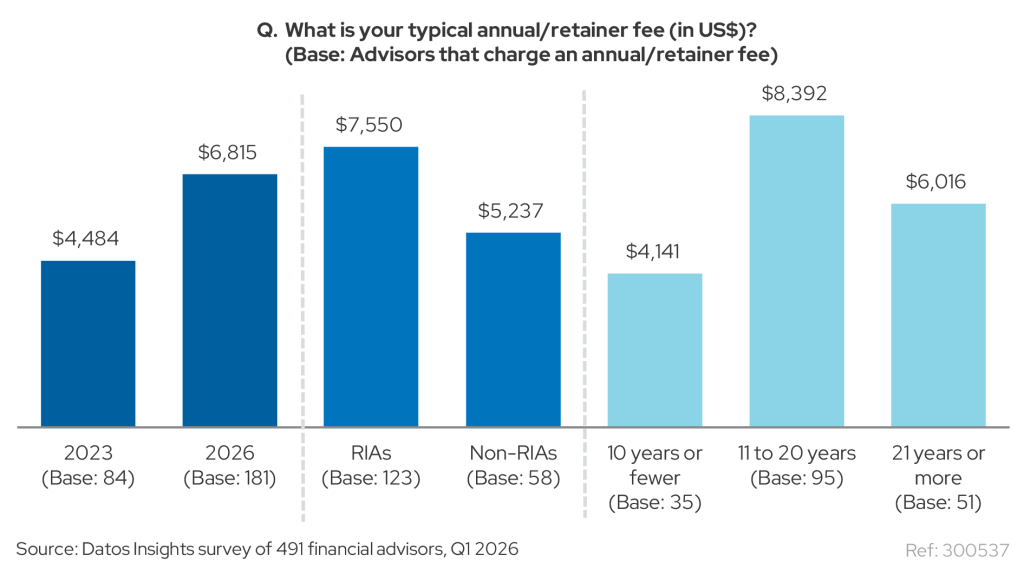
- The retainer fee gap is the widest of any fee type, with RIAs charging 44% more than non RIAs on average.
- RIAs bill a much larger share of their client base for planning.
According to the 2026 State of Financial Planning Fees study from Envestnet | MoneyGuide and Datos Insights, RIA financial planning fees outpace non-RIA fees across most categories, and RIAs bill a larger share of their client base for planning than non-RIAs do.
Let’s dig into the details.
Who is charging for financial planning?
Of the 491 advisors surveyed, 59% of RIAs charge for every financial plan they deliver to clients, compared to just 39% of non-RIAs. Non-RIAs are more likely to charge selectively: 40% charge for some plans but not others, versus just 17% of RIAs.
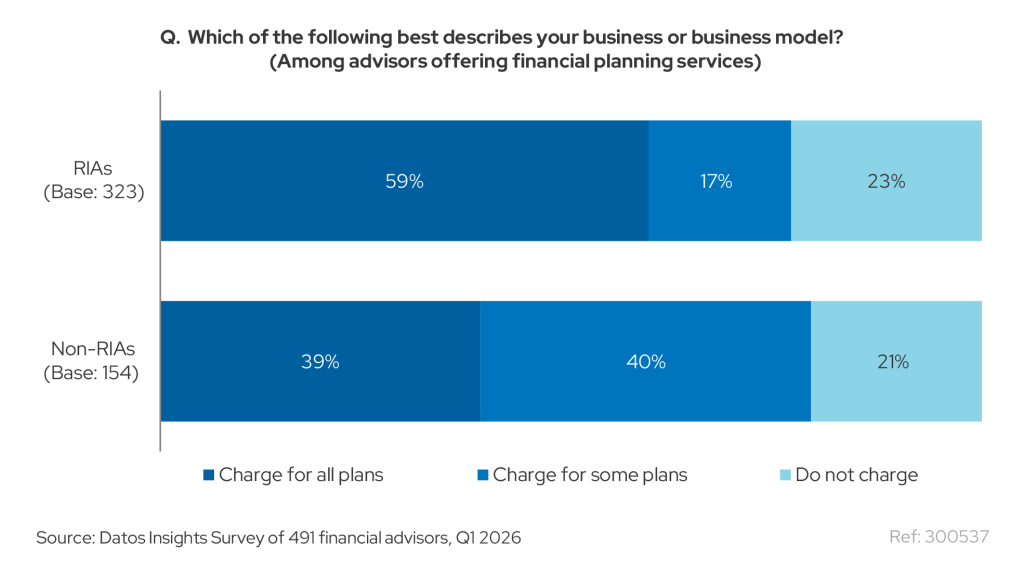
Why are advisors charging for some plans and not others? For most non-RIAs, it usually comes down to complexity: 77% say a complicated plan is the main reason they charge, compared to 38% of RIAs. RIAs, on the other hand, tend to draw the line by client type. Twenty-two percent of RIAs charge financial planning fees to clients that aren't investment management clients, compared to just 2% of non-RIAs.
Ultimately, RIAs are more likely to position planning as a standalone service, while non-RIAs tend to incorporate it into the broader investment relationship.
The difference extends beyond whether advisors charge for planning to how much of their book gets billed. RIAs bill a larger share of their client base:
- 47% of RIAs bill 80% or more of their clients for planning.
- Non-RIAs are more spread out, with 22% billing 80% or more of clients, 21% billing 61–80%, and another 21% billing 41–60%.
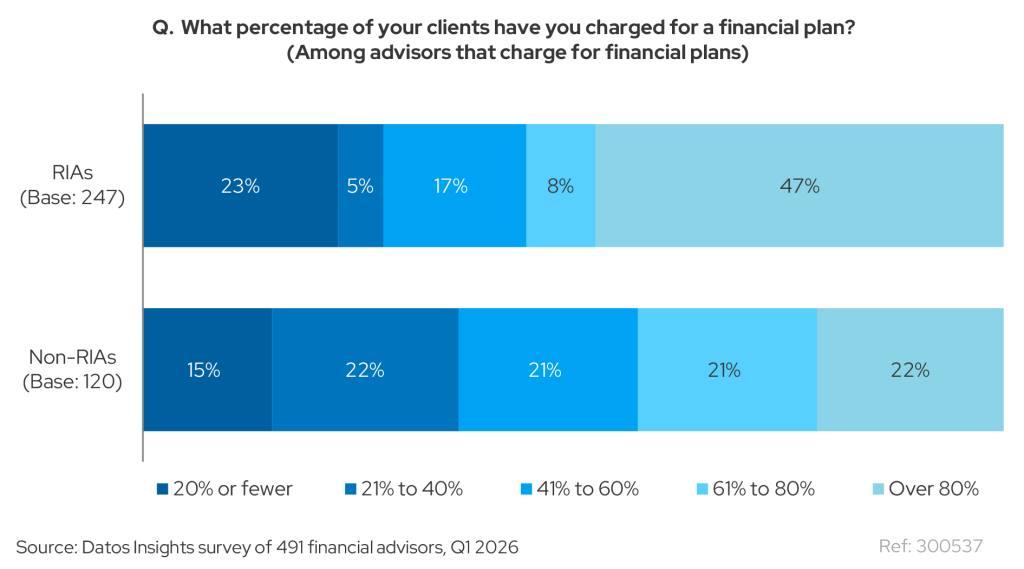
This breadth of billing shows how deeply planning fees have been integrated into advisors’ business models. It also suggests non-RIA advisors are not applying a universal fee policy, but rather making case-by-case judgments.
RIA and non-RIAs favor different fee models
In addition to approaching planning differently, the two channels use different financial planning fee models. Non-RIAs favor flat fees, while RIAs lean more heavily on AUM-based fees and hourly pricing.
- Flat fees were used by 56% of non-RIAs vs. 45% of RIAs
- AUM fees were used by 59% of non-RIAs vs. 63% of RIAs
- Hourly fees were used by 3% of non-RIAs vs. 12% of RIAs
- Retainer fees were used by 39% of both non-RIAs and RIAs
Many advisors use different fee models for different clients. For these advisors, the scope of the client relationship is the leading factor in determining which model applies (46%), followed by AUM level (33%) and plan complexity (16%).
Fees that RIA advisors are charging
Some of the most telling numbers show up when you compare RIA fees vs. non-RIA fees for planning. Here’s how those numbers break down across the five most common fee types.
| Fee Type | RIA Average 2026 | Non-RIA Average 2026 | RIA Premium vs. Non-RIA |
|---|---|---|---|
| Flat Fee | US $3,023 | US $2,771 | +9% |
| Annual/Retainer Fee | US $7,550 | US $5,237 | +44% |
| Monthly Subscription Fee | US $990/month | US $190/month | +421% |
| Hourly Fee | US $310/hour | US $261/hour | +19% |
| AUM/Bundled Fee | 0.94% | 1.01% | -7% |
- Flat fee: RIA advisors charge slightly higher flat fees than non-RIAs – $252 more on average.
- Annual/Retainer fee: Retainer fees show the widest gap of any fee type, with RIAs charging $2,313 more than non-RIAs on average. The size of this gap suggests many RIAs have built planning into their business model as an ongoing, separately valued service rather than an extension of investment management.
- Subscription fee: RIA advisors generally charge subscription fees of $990/month – $800 more than non-RIAs. Even though a smaller number of advisors charged a subscription fee, it’s clear that subscription pricing among RIAs is rising, likely driven by advisors serving younger, income-rich clients through a premium ongoing planning relationship.
- Hourly fee: The average hourly rate increased to $310 for RIAs and $261 for non-RIAs. Overall, fewer advisors are using hourly fees, as billing shifts away from one-off, time-based work and toward ongoing planning relationships.
- AUM or bundled investment-management fee: Non-RIA advisors charge a slightly higher average AUM fee (1.01%) than RIAs (0.94%), reflecting the different client demographics and service models across channels.
Closing the gap
The 44% premium RIAs command on retainer fees reflects more than pricing differences. It highlights a broader approach to positioning financial planning as a clearly defined and consistently delivered service.
When planning is bundled into an investment management relationship, its value can be harder to communicate, measure, and price independently.
Some non-RIAs don’t have a choice. They see the value of charging for planning, but are bound by firm restrictions. Broker-dealer leadership can turn this around by building a clear, compliant way to collect planning fees. This can open up real revenue for the firm and fair pay for the advisor, and can position advisors as true planning professionals.
Ultimately, the gap reflects different approaches to how financial planning is packaged, delivered, and monetized. The firms commanding the highest planning fees aren't necessarily doing more planning. They're more likely to define it, price it, and position it as a distinct service. As planning becomes a larger driver of advisor value and financial planning revenue, that distinction may matter more than ever.
Learn more about how RIAs and non-RIAs are being compensated for planning services: 2026 State of Financial Planning Fees.