Key Highlights
- Learn the differences between tender offer funds and interval funds, including liquidity, redemption schedules and board-approved buybacks.
- Understand how to evaluate tender offer funds through due diligence, client suitability and liquidity considerations.
- Discover how integrated technology can simplify alternative investment onboarding, reporting and ongoing management for financial advisors.
More than 80% of companies with revenues exceeding $100 million are privately held in the U.S.1 Investors increasingly want a piece of that opportunity, as Cerulli data show that advisor allocations to less-than-fully-liquid private-market strategies are expected to rise from roughly $1.9 trillion last year to $3.7 trillion by 2029.2 But the unique operational workflows and non-guaranteed liquidity rules of these structures can make them complicated to implement.
To meet the demand for sophisticated, institutional-grade access to private markets, advisors need a clear understanding of which alternative investment opportunities are available and how to evaluate them for their clients’ specific objectives. Tender offer funds are potentially one such opportunity. Similar to interval funds, but with significant differences, they can offer your clients access to private markets.
Here, we break down what tender offer funds are and how to diligence them for client portfolios.
Understanding tender offer funds
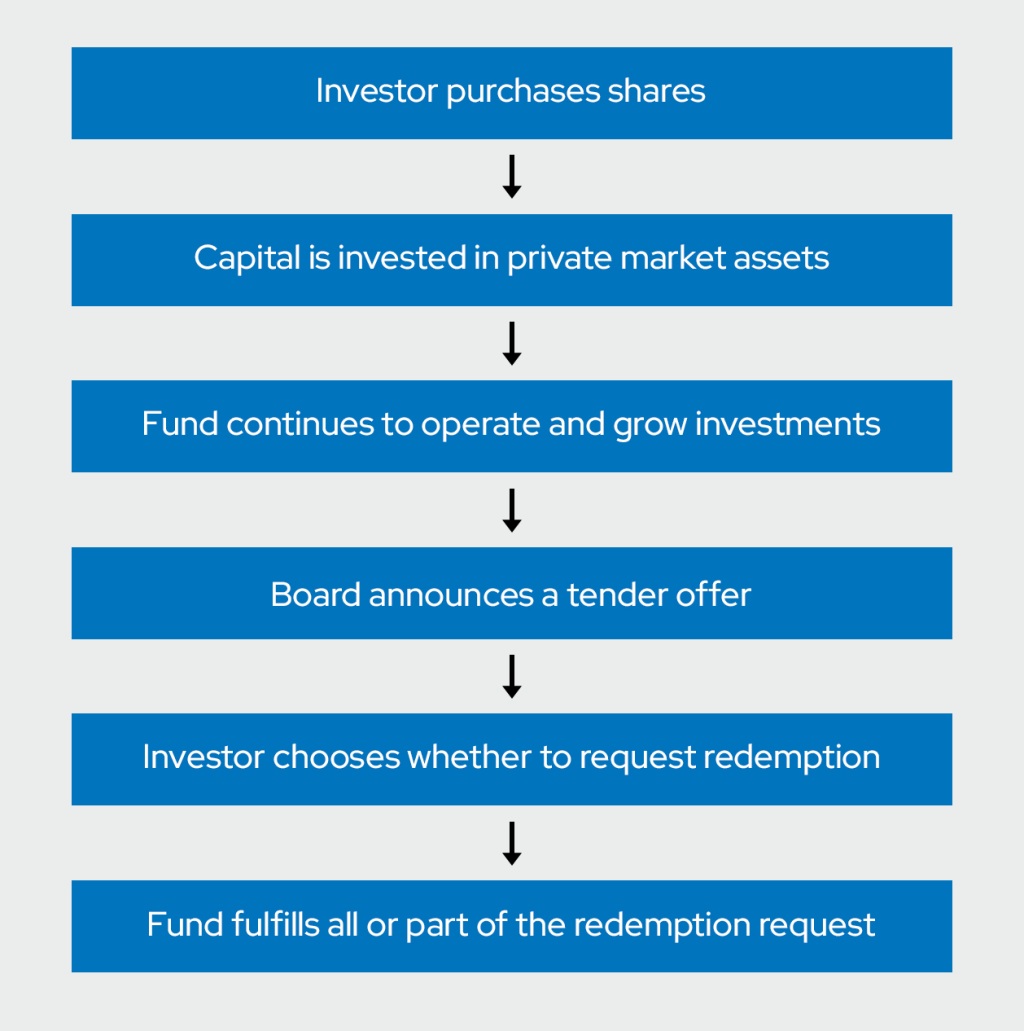
Tender offer funds are registered closed-end investment companies governed under the Investment Company Act of 1940. Rather than offering daily liquidity, they periodically offer shareholders the opportunity to redeem a portion of their investment through board-approved tender offers. This structure allows managers to invest in less liquid private market opportunities that require capital to remain invested.
Tender offer funds vs. interval funds
If tender offer funds sound a little like interval funds, they should. But there is one key difference: interval funds have mandatory redemption schedules. If your client invests in an interval fund, they are guaranteed to have periodic windows to access some or all of their investment. If your client invests in a tender offer fund, those windows are at the board’s discretion. The board’s control protects the core portfolio from asset liquidations during market drops. But it also means that investors may have to give up liquidity for much longer periods than with other investment options.
| Interval funds | Tender offer funds | |
|---|---|---|
| Structure | Closed-end fund | Closed-end fund |
| Exchange listed | No | No |
| NAV calculation | Weekly/Daily | Varies |
| Redemption obligation(i.e. liquidity) | Mandatory | Optional |
| Redemption frequency | Every three, six, or twelve months | Board discretion |
| Redemption threshold | 5-25% of shares outstanding | Board discretion |
How to evaluate these funds for your clients
Given the idiosyncrasies detailed above, it is incredibly important to approach tender offer funds thoughtfully. For some clients, they can be a powerful way for you to offer access they will struggle to find elsewhere. For other clients, tender funds may not be the responsible choice. Here are some steps to think through in your evaluation.
Conduct thorough due diligence
Before recommending a tender offer fund, conduct thorough due diligence to develop a deep understanding of the product. Evaluate the fund's underlying assets, investment strategy, manager track record and fees to determine whether the investment aligns with your clients' objectives and risk tolerance.
It's equally important to understand the fund's liquidity terms. Unlike interval funds, which are required to make mandatory repurchase offers on a regular schedule, tender offer funds conduct buybacks only when approved by the fund's board of directors. Because those repurchase offers are discretionary rather than mandatory, advisors should carefully review the fund's redemption policies and help clients understand how and when liquidity may be available.
Identify eligible and suitable clients
While some funds are available to retail investors, many are limited to clients who qualify as Accredited Investors or Qualified Purchasers, making it important to understand each fund's eligibility requirements before making a recommendation.
Beyond regulatory requirements, consider whether the investment is appropriate for the client's financial goals and liquidity needs. Tender offer funds are generally best suited for investors with a long-term investment horizon of five years or more who are comfortable with limited liquidity in exchange for access to private market opportunities. For some clients, these funds should represent a portion of a broader alternative asset allocation - often between 5% and 20% of the overall portfolio, depending on the client's objectives, risk tolerance, and existing investments.
When discussing with clients, set clear expectations about how the tender process works. Unlike investments with daily liquidity, tender offer funds typically provide quarterly or semi-annual tender offers, during which clients can request to redeem shares if the fund's board approves a repurchase offer. Advisors may find it helpful to explain it this way: "Think of it as a scheduled opportunity to request liquidity -not a guarantee that you can redeem shares whenever you choose."
It is also important to discuss the possibility of proration. If investor redemption requests exceed the number of shares the fund has offered to repurchase, each investor's request may be only partially fulfilled. Helping clients understand this possibility before they invest can build trust and reduce surprises if they decide to redeem shares in the future.
Streamline the subscription and onboarding process
Once you've identified the right clients, focus on streamlining the subscription and onboarding process. In the past, investing in alternatives often involved manual, paper-heavy processes that required advisors to manage multiple forms, disconnected systems, and ongoing administrative tasks. Today, alternative investment platforms and integrated wealth management technology can simplify subscriptions, documentation, and reporting by bringing these investments into existing advisor workflows.
It's also important to understand how tender offer funds are funded. Unlike traditional private equity investments that typically rely on multi-year capital calls, tender offer funds are generally fully funded upfront at the time of purchase. That structure can make the investment process more straightforward for advisors and clients alike while minimizing the need to manage future capital commitments.
Considerations to keep top of mind
Before recommending a tender offer fund, consider:
✓ Does the client understand redemption timing?
✓ What percentage of shares has the fund historically repurchased?
✓ Are incentive or performance fees involved?
✓ Does the client meet eligibility requirements?
✓ Does the client's cash-flow planning account for limited liquidity?
✓ How are valuations determined?
✓ How will holdings be reported and monitored?
✓ Does your firm's operational workflow support ongoing tender management?
Why more advisors are choosing private market tender offer funds
As advisors continue looking for new ways to help clients diversify beyond traditional stocks and bonds, tender offer funds are becoming an increasingly attractive option. In the right situations, these funds can provide access to private market strategies that were once available primarily to institutional investors, while allowing managers to keep more capital invested by reducing the need to hold large cash reserves for regular redemptions. They can also enhance portfolio diversification by introducing return drivers that may differ from those of public markets. And with today's Adaptive WealthTech, advisors can streamline subscription, reporting, and ongoing management processes, making it easier to incorporate private market investments into existing workflows without adding unnecessary operational complexity.
For additional clarity on the complexities of alternative investments, visit Envestnet's Alternatives Research Center.