Key Highlights
- Retirement distribution planning helps advisors turn retirement projections into a practical retirement income strategy for funding a client’s spending needs.
- Social Security, taxes, portfolio withdrawals, RMDs, and other income sources should be evaluated as part of one coordinated plan.
- Looking beyond probability of success can help clients better understand retirement income trade-offs, make more informed retirement decisions, and build greater confidence in their retirement plan.
Clients do not spend probabilities. They spend dollars.
For many clients, retirement brings one major question to the surface: How will I replace my paycheck?
A retirement projection helps keep clients on track during their working years. But once retirement begins, many clients are focused on whether their money will last throughout retirement.
A Monte Carlo analysis can help advisors evaluate that risk by showing how a plan may perform across a range of market outcomes. But retirement is about more than the probability of success.
Clients want to understand where their income will come from, how they should draw from their assets, how taxes could affect withdrawals, and how different decisions may impact their long-term financial security.
The challenge for advisors is helping clients understand how Social Security, portfolio withdrawals, taxes, and other income sources work together to fund retirement over time.
Key decisions that shape retirement income
In many cases, Social Security and taxes play critical roles in retirement. Advisors need to plan to have detailed conversations with their clients about these decisions and their implications.
Social Security filing strategies
Social Security filing decisions can have a meaningful effect on a client’s retirement income strategy. Claiming benefits earlier may provide income sooner, while delaying benefits may increase future income and reduce reliance on the portfolio later in retirement. The trade-off is that delaying benefits may require greater portfolio withdrawals during the early years of retirement.
For married couples, different filing strategies may create additional opportunities to balance current income needs with future benefits. For some couples, one spouse may begin benefits earlier while the higher-wage earner delays, helping to provide income sooner while still capturing some of the potential benefit of delayed filing.
Rather than evaluating Social Security in isolation, advisors can consider how each filing decision affects the client’s overall cash flow, portfolio withdrawals, taxes, and other retirement goals.
Tax-smart withdrawal strategies
Tax-efficient distribution planning can help advisors show clients how the timing and source of withdrawals may affect their retirement outcomes. For example, tax planning might identify years when the client may be in a lower tax bracket early in retirement. That could create an opportunity to consider Roth conversions or qualified distribution strategies before future Required Minimum Distributions (RMDs) increase taxable income.
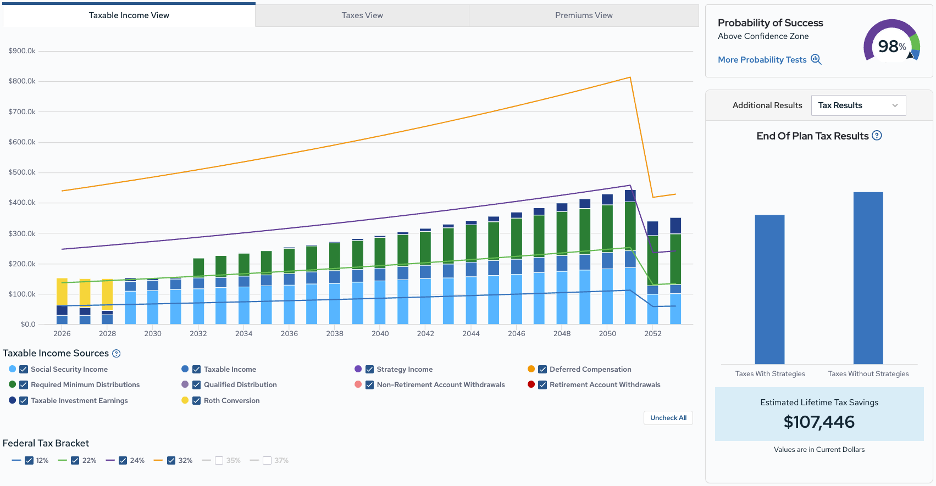
A Roth conversion strategy may help reduce future RMDs, smooth taxable income over time, and potentially improve the after-tax legacy left to heirs. In the example shown, the Roth conversion strategy helped reduce future RMDs and produced lifetime income tax savings in the average-return scenario.
A qualified distribution strategy may offer another option. Rather than converting assets to Roth, clients may spend from qualified assets in lower-tax years, helping reduce future RMDs while funding retirement expenses.
The value of these conversations is not just in the calculation. It is in helping clients see the “why” behind a recommendation: why withdrawing from one account before another may matter, why a lower tax bracket year may create an opportunity, and why the order of distributions can influence the long-term plan.
How to account for market volatility
Market volatility can be challenging for retirees who are relying on their portfolios for income. A cash reserve strategy can help set aside a portion of the portfolio in a more liquid, conservative allocation to fund near-term retirement expenses during periods of market decline or volatility.
The idea is simple: if the market declines, the client may choose to draw from the cash reserve rather than selling long-term assets. during a downturn. If market conditions improve and the client's circumstances warrant, the cash reserve may be replenished over time.
This approach may be especially helpful for clients who are nervous about market volatility and tempted to shift their entire portfolio into a more conservative allocation. By separating short-term spending needs from long-term portfolio assets, advisors can help clients better understand why the rest of the portfolio may still need to remain invested for growth.
Total income views show how retirement gets funded
Clients need a clear way to see how their goals may be funded throughout retirement. Total income views can help illustrate how sources such as the following may work together over time:
- Social Security
- Pensions
- Required minimum distributions
- Annuity income
- Portfolio withdrawals
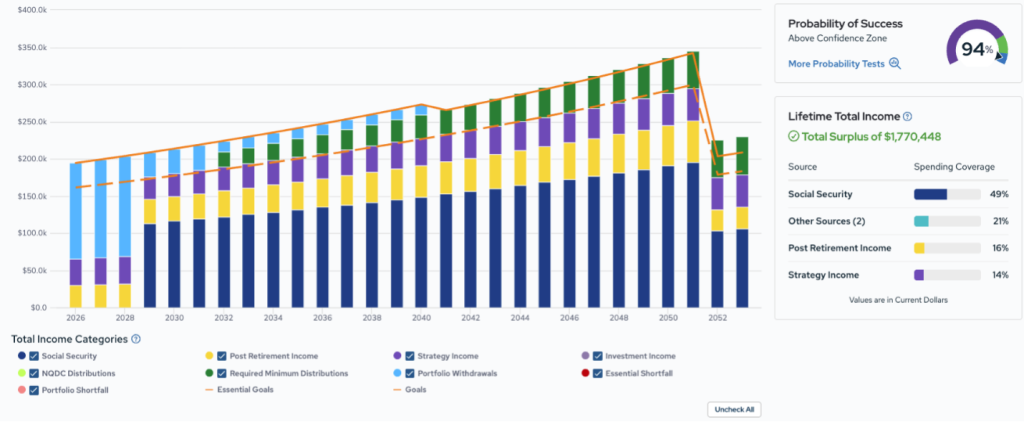
This type of visual breakdown can be especially helpful because it separates essential goals from discretionary ones. Clients may be more comfortable accepting some market variability around wants and wishes — such as travel, gifting, or other lifestyle goals — if they can see that their essential needs are addressed first.
It also helps reveal planning opportunities. For example, in some cases, RMDs may eventually exceed a client’s spending needs, creating a potential tax-planning opportunity. The early years of retirement may involve greater reliance on the portfolio before Social Security and RMDs begin.
Build a more complete retirement picture
The probability of success remains an important metric in retirement planning. But it does not tell the entire story. Advisors may also want to consider how a strategy affects:
- Essential income needs
- Ending portfolio values
- Federal income taxes
- Medicare premiums
- Social Security lifetime benefits
- Liquidity
- The trade-offs associated with different income strategies
Looking at these outcomes together can create a more complete picture of the retirement plan. Instead of simply showing that one strategy has a higher probability of success, advisors can help clients understand how each strategy changes, what benefits they may receive, and what trade-offs they may need to accept.
A retirement projection can help answer an important question: Is the client on track?
Distribution planning answers the next question: How will I fund retirement?
By bringing together income sources, spending needs, taxes, and portfolio withdrawals, advisors can help clients better understand the strategic decisions that can change their retirement outcomes.
A simulation can show whether a retirement plan may work. Distribution planning helps clients understand the money they will live off of.
Map out your client's retirement years with Envestnet MoneyGuide’s Retirement Cash Flow Chart.