Key Highlights
- Private credit offers a different way to take credit risk. Returns are driven more by borrower fundamentals, underwriting and deal structure than by the daily repricing of public markets.
- Lower reported volatility doesn’t tell the whole story. Valuation methodologies, leverage, credit quality, and manager selection are among the factors that may affect investment outcomes.
- Private credit isn’t immune to equity risk. Borrower fundamentals, leverage, and sponsor activity can create meaningful links between private credit and equity markets, even as the asset class offers different sources of return.
Ask most advisors why they're allocating to private credit and it’s likely you’ll hear similar answers like: it diversifies the portfolio. Low correlation to public markets. Steadier returns. A smoother ride when equities get choppy.
These perceptions aren’t necessarily wrong. But private credit’s diversification benefit has less to do with being insulated from economic risk than with how market structure, valuation mechanics, and risk exposures shape its performance.
Private credit’s diversification profile can be understood across five dimensions: correlation, volatility, return distribution, risk factor exposure, and market structure. Together, these dimensions help clarify where private credit can complement a traditional portfolio, and where its risks may overlap with assets investors already own.
Here’s what the data shows, and why it matters for the conversations advisors are having today.
Correlation: Diversification isn’t isolation
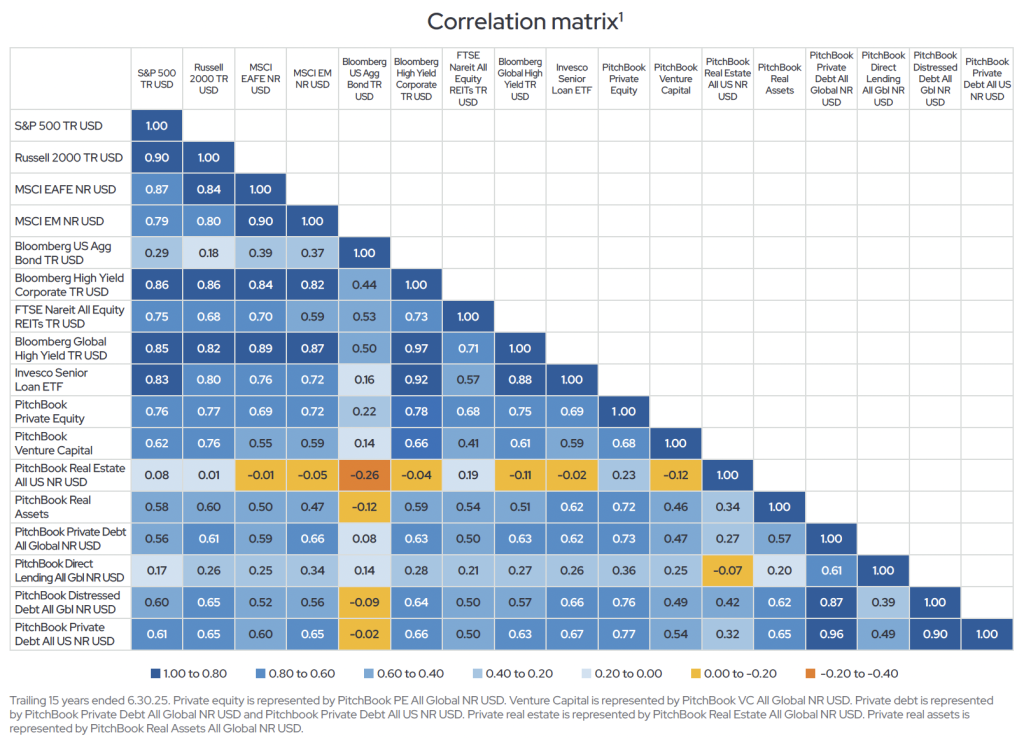
Private credit has historically shown low correlation with investment grade debt and several other private asset classes, while its correlation with leveraged loans and high yield has been higher. Its relationship with equities can also be stronger than expected, because borrower fundamentals, leverage, and sponsor activity ultimately drive both equity and credit outcomes. Private credit can diversify a traditional portfolio, but it isn't insulated from economic or equity market risk.
Volatility: Look beyond the headline
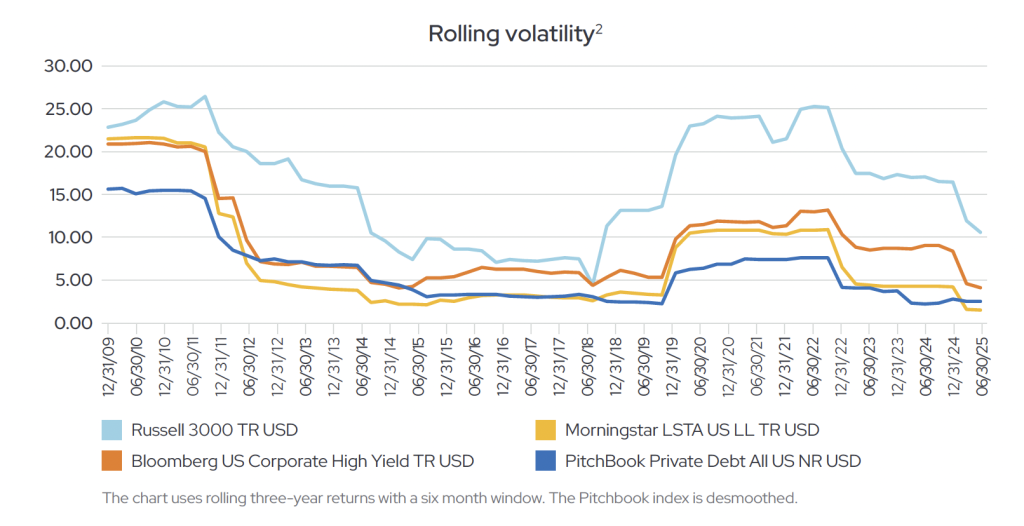
Reported volatility for private credit has generally been lower than for public credit, but that difference is partly a function of how private assets are valued. Infrequent, model-based valuations may result in less variable reported returns than daily market pricing. Direct lending also has structural features, including floating rates, seniority, and covenants, that can help reduce volatility, while more opportunistic strategies such as distressed debt can behave much more like public high yield.
Return dispersion: Manager selection matters
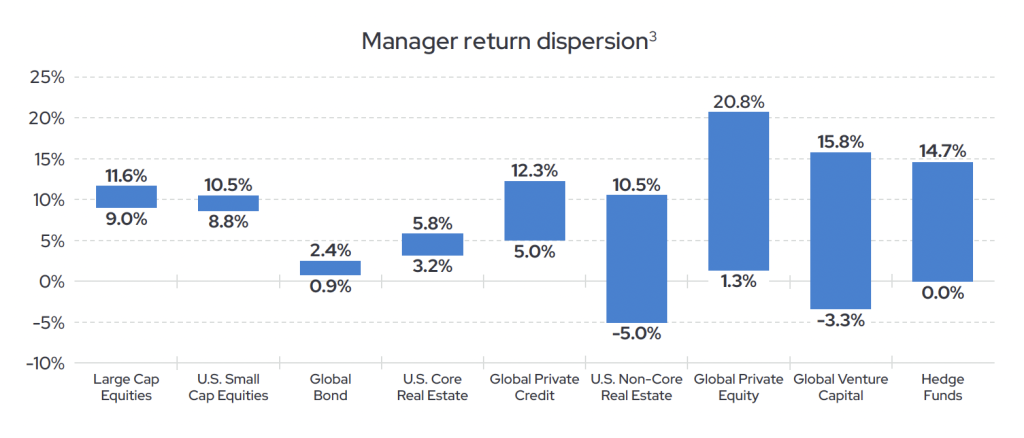
Historically, private credit has produced wider dispersion of returns than public fixed income, where market-wide factors drive much of performance. In private markets, sourcing, underwriting, deal structure, and workout capabilities can create significant differences between managers. Dispersion also varies across strategies: direct lending tends to be more consistent, while asset-based finance and distressed credit can have greater variation in outcomes and greater reliance on manager skill.
Risk factors: Different ways to take credit risk
Public and private credit are exposed to many of the same economic forces, but those forces affect returns differently. Public bonds are continuously repriced based on interest rates and credit spreads, while private credit returns are driven more by borrower fundamentals, underwriting, collateral, seniority, and realized defaults and recoveries. Floating rates reduce duration exposure, but private credit is better viewed as a credit investment than an inflation hedge. It can also carry meaningful equity-like downside in stressed environments.
Different sectors, different exposures
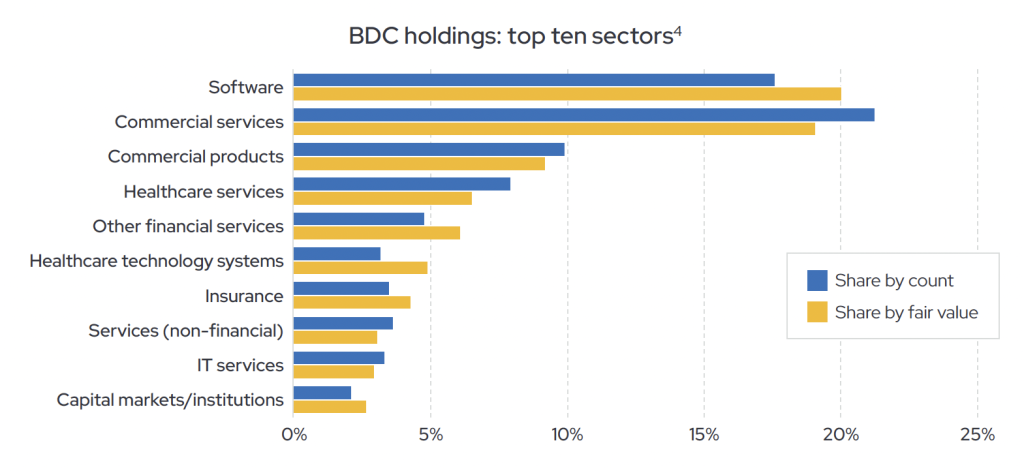
Private credit strategies have different underlying sector exposures than public markets. Direct lending tends to favor asset-light sectors such as software, business services and healthcare, while public high yield has greater exposure to areas such as energy and consumer sectors. Those differences in sector exposure can meaningfully shape how private and public credit perform across market cycles.
A note on semiliquid structures
Traditional closed end drawdown private credit funds typically don’t offer intermittent liquidity. Conversely, newer semiliquid vehicles offer periodic liquidity while still holding predominantly illiquid loans. That dual mandate requires a different portfolio structure than traditional drawdown structures, but discussions of historical performance in private credit generally refer to the drawdown experience. Over time, portfolio construction differences may lead to diverging outcomes. For advisors, the vehicle matters: a semiliquid private credit fund shouldn't automatically be expected to behave like a traditional drawdown fund.
So where does private credit actually fit?
Private credit isn't a replacement for public bonds, nor is its value simply that it is less correlated with other assets. Its role is to give investors another way to invest in credit, with different exposures, structures, and sources of return.
That makes private credit particularly relevant as a complement to public fixed income, especially investment grade debt. But it shouldn’t be viewed as a substitute for the liquidity, transparency, or defensive characteristics of traditional bonds. Private credit remains exposed to borrower fundamentals, leverage, and economic cycles, and some strategies have meaningful overlap with leveraged loans and high yield.
For advisors, the question to ask isn’t simply whether private credit is “diversified,” but how it changes the mix of credit risk in a client’s portfolio.
Done thoughtfully, private credit can add diversification, income, and access to a broader set of credit opportunities. The goal isn't to eliminate credit risk, but to diversify how it is taken, to create portfolios with more than one path to long-term returns.
To go deeper, read our white paper on private credit: Diversification Demystified.