Key Highlights
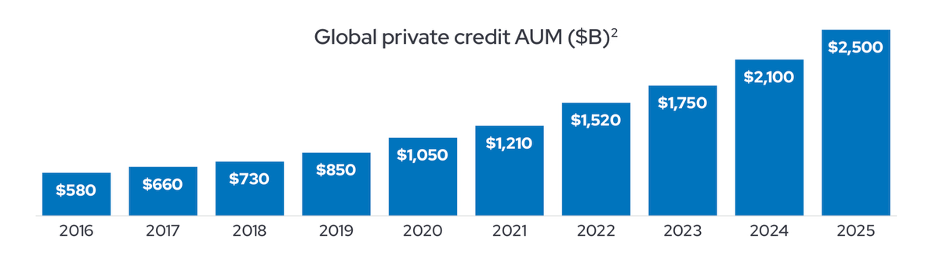
- Private credit has grown into a nearly $2.5 trillion asset class, though it still currently represents a small share of global fixed income.
- Floating rates, direct origination, and custom loan terms set private credit apart from traditional fixed income.
- Direct lending, distressed debt, special situations, asset-based finance, and structured credit are each designed to serve different portfolio goals.
- Infrequent valuations can typically smooth reported volatility, which may understate underlying credit risk.
Private credit has grown from a niche corner of the credit markets into a roughly $2.5 trillion asset class.1 That growth has brought more lenders, more borrowers, and more ways to invest in the space. But before evaluating private credit's potential role in a portfolio, it’s important to understand the mechanics of this asset class. Distinct structural features like direct origination, custom loan terms, and floating rates make private credit behave differently from traditional fixed income. Understanding these differences is key to confidently navigating the private credit landscape for your clients.
What is private credit?
Private credit (also known as private debt) refers to direct provision of capital through privately negotiated loans that are not publicly traded. Instead of borrowing from traditional commercial banks or issuing public bonds, companies secure financing from private asset managers, specialized debt funds, and Business Development Companies (BDCs). Because the loans are privately negotiated and customized for each borrower, they're illiquid and can't be easily traded on public exchanges.
How private credit has grown in the last decade
The concept of private credit isn’t new. It has existed for roughly 30 years as a funding alternative for small and mid-sized businesses that were too small for public bond markets and too complex for traditional bank underwriting.
The 2008 Financial Crisis marked a turning point, setting off a wave of unprecedented growth.
As stricter global banking regulations forced traditional banks to retreat from middle-market lending, non-bank institutional lenders stepped in to fill the void, creating the non-bank lending ecosystem we see today.
How big is the private credit market?
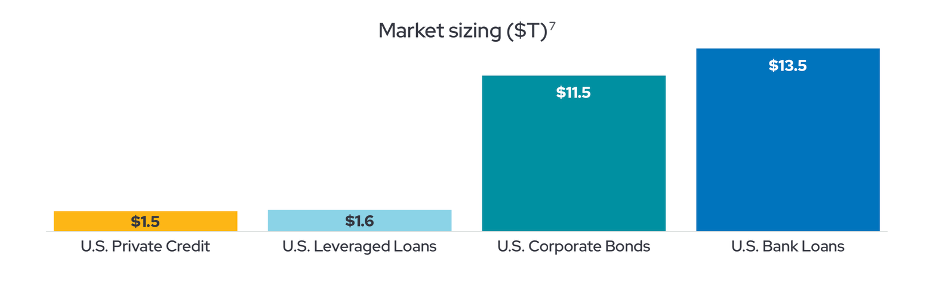
Despite the headline growth, private credit is still a relatively small piece of the overall debt market. According to NEPC, citing SIFMA's 2024 Capital Markets Fact Book, the asset class represents about 1.1% of total global fixed income assets3.
About three-quarters of the private credit market is in the U.S., according to the IMF’s April 2024 Global Financial Stability Report.4 The IMF also estimates that private credit accounts for approximately 7% of credit to non-financial corporations in North America, a share comparable to broadly syndicated loans and high yield corporate bonds. And even at $2.5 trillion in AUM in across institutional, private wealth and insurance capital1, private credit is dwarfed by the roughly $6 trillion private equity market, according to KPMG.5
While most private credit today is still held by institutional investors, the investor base is shifting. The rise of limited trade window funds, like interval funds and non-traded BDCs, has opened the door to retail investors, whose share of global private credit AUM grew from virtually zero in the early 2010s to roughly 13% by the mid-2020s, according to the Bank for International Settlements.6
Who’s lending and who’s borrowing?
The private credit investor base consists of insurance companies, pension and sovereign wealth funds, asset managers, and family offices. Retail investors are increasingly entering the space through asset managers, which pool capital into fund structures like interval funds and Business Development Companies (BDCs).
On the other side of the ledger, borrowers are typically middle-market enterprises with revenues spanning $10 million to $1 billion.8 Because these companies lack the scale to efficiently issue public bonds, they utilize private debt to fund day-to-day operations, refinance existing debt, or finance private equity-sponsored buyouts.
What are the key features of private credit?
To understand how private credit fits into a modern asset allocation, it helps to look at its core structural characteristics:
- Credit Profile: Most middle market borrowers would likely be classified as below investment grade if they issued public debt.
- Structural Protections: Loans are typically structured with senior secured positioning, giving lenders first-priority claims on the borrower's assets in default.
- Interest Rate Mechanics: Unlike traditional fixed rate bonds, private credit predominantly uses floating rate coupons, which helps mitigate duration risk as interest rates fluctuate.
- Maturity Profiles: Maturities resemble public high yield bonds, though effective durations tend to run shorter due to the floating rate structure.
What are the main investment strategies?
Private credit isn't a single strategy, but a spectrum offering an array of portfolio outcomes for investors. Each strategy serves a different purpose for the borrower.
- Direct lending – The largest segment of private credit, often estimated at more than half the market. These are loans made directly to private, often PE-backed, companies.
- Distressed debt – Loan origination to financially troubled companies, where returns depend on restructuring outcomes rather than steady cash flows.
- Special situations – Flexible, opportunistic financing for nonstandard or transitional situations, where returns come from structuring and complexity rather than borrower distress.
- Asset-based finance (ABF) – One of the fastest growing segments of private credit, covering asset secured lending outside traditional bank channels. This includes asset based lending, a direct loan or credit line secured by specific assets like inventory or receivables, and asset-backed securities, which pool those loans into tradable securities.
- Structured credit – Packages a broader group of loans or receivables into securities, such as collateralized loan obligations and mortgage-backed securities.
Direct lending tends to be focused on generating income, while distressed debt and special situations offer capital appreciation potential beyond pure yield.
How does private credit differ from public credit?
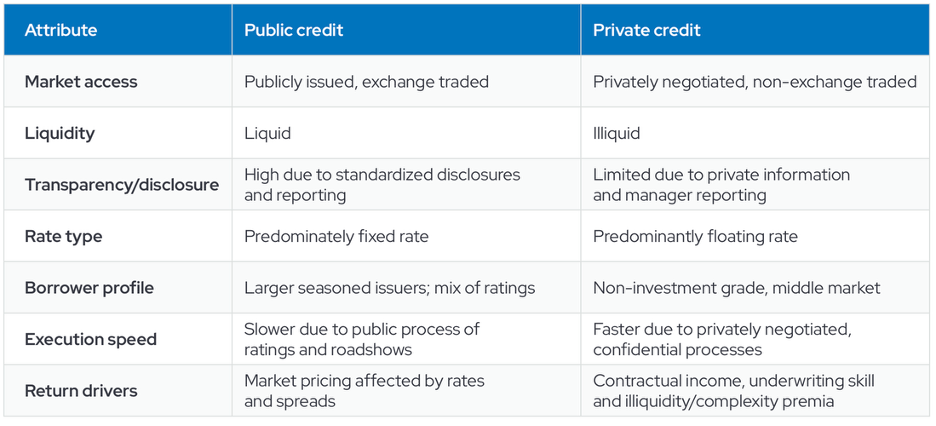
Private credit loans are negotiated directly between lender and borrower, allowing terms and covenants to be customized. That flexibility comes with a pricing tradeoff, as private credit spreads over the Secured Overnight Financing Rate (SOFR) generally carry a premium compared to public leveraged loans.
Public credit, by contrast, can offer greater transparency and liquidity but requires a slower execution timeline due to formal ratings and roadshows.
How does private credit perform for investors?
Private credit, particularly direct lending, has historically delivered strong returns with lower reported volatility than public credit alternatives like high yield bonds and leveraged loans. This combination of steady yield and potential downside protection has driven advisor and institutional interest in the asset class.
However, lower reported volatility comes with an important operational caveat. Because private loans are typically valued quarterly using internal models rather than continuous public trading, reported valuations do not fluctuate based on daily market sentiment. This lag can create a “volatility smoothing” effect and delay how quickly reported returns reflect underlying credit stress. While some institutional indices mathematically “desmooth” returns to better reflect underlying risk, it’s important to remember that headline volatility numbers in private markets don't always tell the whole story.
The bottom line
Private credit has moved from a niche lending alternative to a mainstream fixed income allocation, and that shift shows no signs of slowing. For advisors, that means more tools to build differentiated portfolios and more ways to meet growing client demand for income and diversification. Understanding how these loans are structured, priced, and valued is one of the first steps toward putting this growing asset class to work for your clients.
Learn more about private credit with our Private Credit Fundamentals report.